

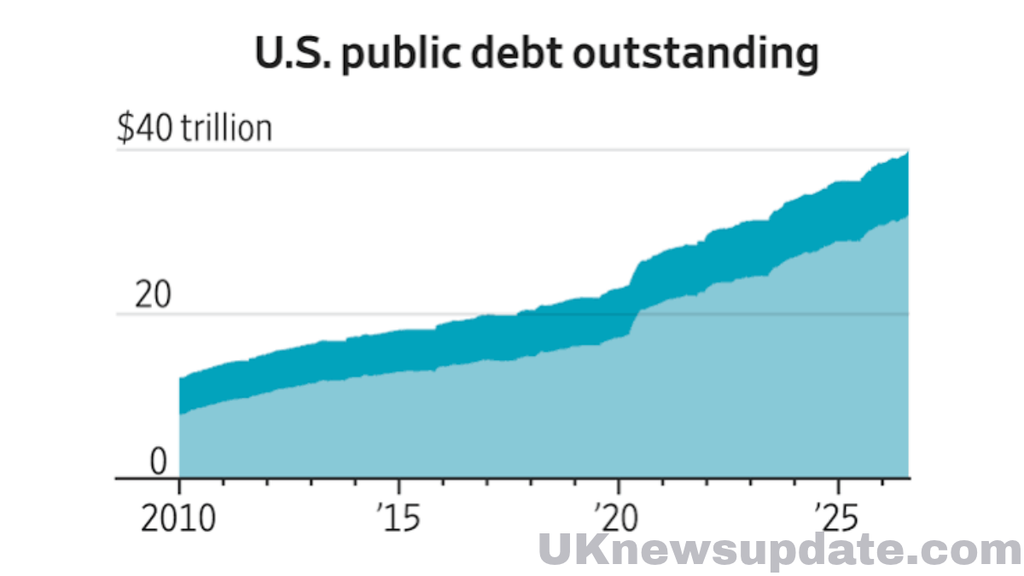
In the month of August, the US Treasury achieved a milestone of national debt surpassing 40 trillion dollars. This is a record level in the United States’ financial history. This historic milestone of government borrowing has raised concerns among policymakers, financial analysts, and economists. They are concerned about the country’s long-term stability and its debt costs.
According to reports from official news sites, the United States Treasury Department concluded that the total debt has reached 40.047 trillion dollars on August 18. The government is continuously facing a budget deficit. The government is continuously facing a large budget deficit. Rising interest repayments and growing public demand for goods are also a concerning matter for the government. These concerns are centered to the government of United state how it will manage all these.
What does a treasury debt mean?

The treasury debts are amount of money that a country owes to another country and its government. A country’s debt increases when it does not export as much as it imports or its expenditures exceed the revenue collected through taxes and other sources.
In the US, the Treasury debt includes two different categories. First held by the public and second the debt is held by the governments. According to the reports from the US Treasury, the debt held by the public is estimated 32.2$ trillion. The government-held debt is approximated at 7.8 trillion dollars.
The debt has increased at more than double the rate since January 2017. At that time, it stood at approximately 19.95 trillion dollars. The increase in the debt during these years represents government spending, spending during the COVID-19 pandemic, tax policies, and economic support programmes.
Although the United States economy is the world’s strongest economy. the rise in debt raises questions and concerns. Concerns about whether the government will be able to sustain future debt. Will it be able to repay its debt, and is it sufficient to cover future spending commitments and interest payments?
Why is the US Treasury debt increasing?
One of the main reasons for the increase in US Treasury debt is the increased gap between government revenue and federal spending. When a government spends more money than it collects, it borrows money to cover the expenditure.
The federal government spends on Social Security, Medicare, national defence, education, public services, infrastructure, and payment of interest on already existing debt. Many of these expenditures are difficult to reduce because these are long-term government commitments and major government support programmes for the public. A state cannot compromise on its public goods.
Tax policy is also a way to generate government revenue. When taxes are low, the public, households, and businesses have more money to spend and invest. But this can also reduce government revenue, which directly affects the treasury. Economic emergencies have also contributed to the rise of US Treasury debt. The COVID-19 pandemic, the Russia-Ukraine war, and now the US-Iran conflict are major events that cost the US a lot. Military support was increased through funding, which increased the debt as well.
The problem is not just only of US government and president only, but it concerns the whole administration. It can also affect the world economy; if the US dollar value went down, the whole world’s trade would suffer.
How can debts affects ordinary public in US?
The US treasury debts is not just governments’ accounting issue, it can reach to public, household and businesses. It can affect every citizen through financial markets, borrowing costs, and future budget decisions.
When the US Treasury issues bonds for debt, investors invest in high-return investments. The government increases the investment return, but it also increases interest rates throughout the economy. That means the borrowing costs for businesses also increase.
Moreover, the US treasury debts are balances through reducing government spendings and increase in tax collections. When taxes are increased in the economy, it directly affects people, households, and businesses. The direct effect is in a way that prices of everything increase when the government increases the tax.
What could happen next?
The main question here is how the government will pay U.S. Treasury debt. The more time it takes to return,n the more the cost of repayment will be. Another factor affecting this is the instability of the economy. The US treasury debts will cause a instability in the economy, where imports will exceed exports and tax collection will be less than the spendings.
Increase in tax could help the government to raise revenue but it comes with a cost for households and businesses. Spending reductions could slow borrowing but might also affect public services or government-supported programmes.
For policymakers, investors, the public, and business owners, the concern is not how much the US Treasury debt is, but how the government will manage spending and expenses to reduce the debt. We will see whether the US Treasury will be able to manage the national debt while managing expenses and economic growth.
You can also get information about:
US Rise in Corporate Profits Due to AI Boom
Economic consequences of Russia sanctions: Trump decided to lower the tariffs on Russia